Is Dry Needling the Same as Acupuncture? What Patients Should Know
If you have ever looked up dry needling and ended up reading about acupuncture, or vice versa, you are not alone. The two treatments share one obvious feature: a thin needle going into the body. From a patient's perspective, it is a reasonable question. Are these the same thing?
The short answer is no. They share a tool, not a purpose. And understanding the difference is worth your time if neck tightness, low back stiffness, muscle pain, or a stubborn sports injury is limiting what you do day to day.
This post breaks down what dry needling is used for, how acupuncture fits into the picture differently, and how to figure out which one makes sense to ask about at your next appointment.
Why Do Patients Mix Up Dry Needling and Acupuncture?
Both treatments use very fine, solid needles. Both involve lying still while a clinician places those needles into the body. The setup looks similar on the surface, and that is where most of the confusion starts.
But the needle is not the defining feature. What matters is why the needle is being used, where it is placed, and what the clinician is trying to change. As reviewed in regulated healthcare contexts, dry needling and meridian-based acupuncture differ in their clinical rationale and point selection frameworks, even when the physical tool appears identical.
So, is dry needling the same as acupuncture? No. They look similar from the outside, but they serve different clinical purposes depending on the provider's training and your goals.
What Is Dry Needling Used For?
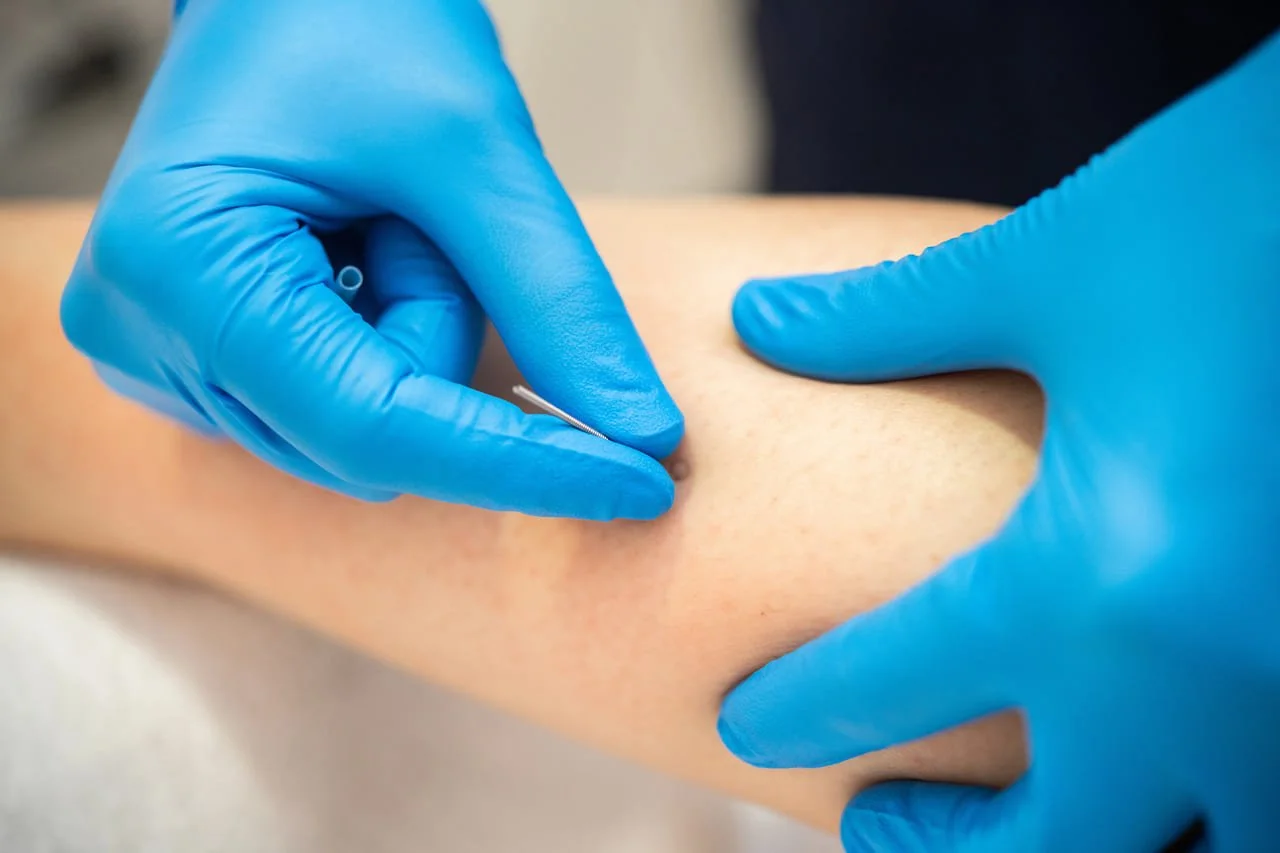
Dry needling is a technique where a clinician inserts a thin needle directly into a tight, sensitive area of muscle tissue, often called a trigger point, to reduce local tension and support better movement. The goal is specific: address the muscle, reduce its sensitivity, and help the surrounding area function with less restriction.
Common reasons someone asks about dry needling include:
Neck and shoulder tightness from long hours at a desk
Low back stiffness that limits sitting, lifting, or rotating
Headaches connected to muscle tension in the neck or upper back
Calf, quad, hamstring, or hip tightness in runners and athletes
Overuse injuries where the muscle feels guarded or movement feels restricted
Patients often describe these areas as "muscle knots." Clinicians use terms like trigger points, elevated tone, or protective guarding. The language differs, but the target is the same: a localized area of muscle that is tight, sensitive, and limiting your range of motion or tolerance to load.
Dry needling for these areas may help reduce local sensitivity and improve how comfortably you move through that range. Research supports framing it as one component of a broader treatment plan that includes exercise and active rehabilitation, rather than a standalone fix.
How Does Acupuncture Fit Into the Picture?
Acupuncture is a distinct needle-based treatment with its own training requirements, clinical reasoning, and scope. It is not a lesser version of dry needling, nor a less clinical one. It operates through a different framework entirely.
Where dry needling focuses on specific muscles and movement-related goals, acupuncture uses a different assessment method and point selection approach. Depending on the provider's training and the patient's presentation, acupuncture is used for pain modulation, tension relief, stress-related symptoms, and broader treatment goals within that model of care.
As noted in research examining needle-based techniques, treating these approaches as interchangeable overlooks meaningful differences in their clinical rationale and application.
At OCR, practitioners use both. The right tool depends on the goal, the provider's scope and training, and what your body needs at that stage of care.
| Feature | Dry Needling | Acupuncture |
|---|---|---|
| Primary target | Muscle tissue, trigger points, movement restriction | Point selection based on acupuncture framework and clinical reasoning |
| Clinical framework | Musculoskeletal, movement-based | Traditional or integrative acupuncture model |
| Common goals | Reduce muscle tension, improve movement tolerance | Pain modulation, relaxation, symptom support |
| Used in isolation? | Rarely; typically paired with manual therapy, exercise, or rehab | Varies; used alone or alongside other treatments |
What Does Dry Needling Actually Feel Like?
This is one of the most common questions, and it is worth answering honestly.
When a needle reaches a trigger point in a tense muscle, you may feel a dull ache, a pressure sensation, or a brief involuntary twitch response. That twitch is normal and often a sign the needle has engaged the right area. Some patients experience mild soreness in the treated area for a day or two afterward, similar to how a muscle feels after a focused workout.
Dry needling for neck and back pain tends to involve smaller, more superficial muscles. The sensation is typically described as a dull pressure. Dry needling for sports injuries in larger muscle groups, such as the glutes, calves, quads, or hamstrings, may feel more noticeable given the size and depth of the tissue involved.
Your clinician should explain what to expect before starting, check in during treatment, and adjust if something does not feel right. You are not expected to tolerate discomfort without question. Treatment should be explained, consented to, and controlled throughout.
Dry needling should always be performed by a trained, regulated healthcare provider using appropriate screening and clean technique.
Why Would a Physiotherapist or Chiropractor Choose Dry Needling?
A trained physiotherapist or chiropractor may both be appropriate providers for needle-based care, depending on their scope, training, and your goals. The choice of dry needling over other approaches is typically driven by what the assessment reveals about how you move and where the restriction lives.
Dry needling is rarely used on its own. It is usually one part of a plan that includes manual therapy, mobility work, strengthening, exercise progression, electro-stim, taping, or postural and activity modifications. The needle addresses the tight, sensitized tissue; the rest of the plan builds on what that creates.
The goal is not just to reduce pain in the moment. It is to help you move with less restriction, return to training or sport more comfortably, sit and lift with better tolerance, and build toward function that holds beyond the treatment room. Pain relief is the first priority. What comes after that is what makes the plan worth following.
Learn more about how Dry Needling fits into care at OCR, or explore how acupuncture is used alongside other approaches at the clinic.
How Do You Know Which Option to Ask About?
You do not need a clinician to decide before you start moving. Keep doing what your body tolerates, whether that is walking, light stretching, or gentle mobility work, and use the following as a guide for where to direct your questions.
Dry needling is worth asking about if:
A specific muscle feels persistently tight, knotted, or guarded
Stretching provides only short-term relief before tightness returns
Pain is limiting your training, lifting, desk work, or sport
You want treatment connected closely to movement and exercise progression
Acupuncture is worth asking about if:
You are looking for a broader needle-based approach
You have responded well to acupuncture before
Your goals include pain modulation, relaxation, or symptom support within that model of care
If you are experiencing unexplained severe pain, progressive neurological symptoms, fever, significant trauma, or symptoms that do not fit a typical musculoskeletal pattern, seek appropriate medical assessment before starting any needle-based treatment.
Key Takeaways
Dry needling and acupuncture both use thin needles but differ in clinical framework, point selection, and intended goals.
Dry needling targets muscle tissue, trigger points, and movement restrictions within a musculoskeletal approach.
Acupuncture uses a distinct assessment method and is not simply an older version of dry needling.
Both treatments are used at OCR.
Dry needling is most useful when paired with manual therapy, exercise, and a broader rehabilitation plan, not as a standalone treatment.
A trained physiotherapist or chiropractor can assess which approach fits your presentation and goals, and both are equally valid pathways to explore.
Ready to Figure Out What Works for You?
If you are weighing dry needling vs acupuncture because neck pain, back stiffness, muscle tightness, headaches, or a sports injury is getting in the way, Ossington Chiropractic and Rehabilitation (OCR) offers both. Our boutique clinic on Ossington Avenue in Toronto brings together physiotherapists and chiropractors who can assess how you move, explain what your options are, and build a plan alongside you.
Pain relief is the first priority. Getting you back to what you do is the next step. We will be with you every step of the way.
Book a visit with OCR to discuss dry needling, acupuncture, physiotherapy, or chiropractic care at our Ossington Avenue clinic.
Frequently Asked Questions
Is dry needling the same as acupuncture?
No. Both use thin needles, but dry needling targets muscles, trigger points, and movement restrictions within a musculoskeletal framework. Acupuncture uses a different clinical rationale and point selection approach. Both are useful tools, and the right fit depends on your goals and your provider's training.
Does dry needling help muscle knots?
It may help some people reduce sensitivity in tight, knotted muscle areas. Many patients notice improved movement tolerance when dry needling is paired with manual therapy, exercise, or other active care that supports the area after treatment.
Can a chiropractor or physiotherapist provide dry needling?
In Ontario, whether a chiropractor or physiotherapist offers needle-based treatment depends on their regulated scope, training, and authorization. A trained physiotherapist or chiropractor at OCR can assess your situation and explain whether dry needling, acupuncture, or another approach is the right fit for you.